What is hazardous tree felling?
Unlike normal felling in the forest, where the tree has room to fall freely, hazardous tree felling is done in a limited space. These are situations where the fall of the entire tree could directly endanger:
family houses, neighboring buildings or pergolas,
power lines and utility networks,
fences, pools or ornamental planting,
public roads and busy sidewalks.
Professional procedure: How we cut down trees using the tree rope access techniques
In hazardous tree felling, we do not use a heavy technique (unless absolutely necessary), but a method gradually cutting off parts of the tree. This approach is gentle on the surrounding terrain.
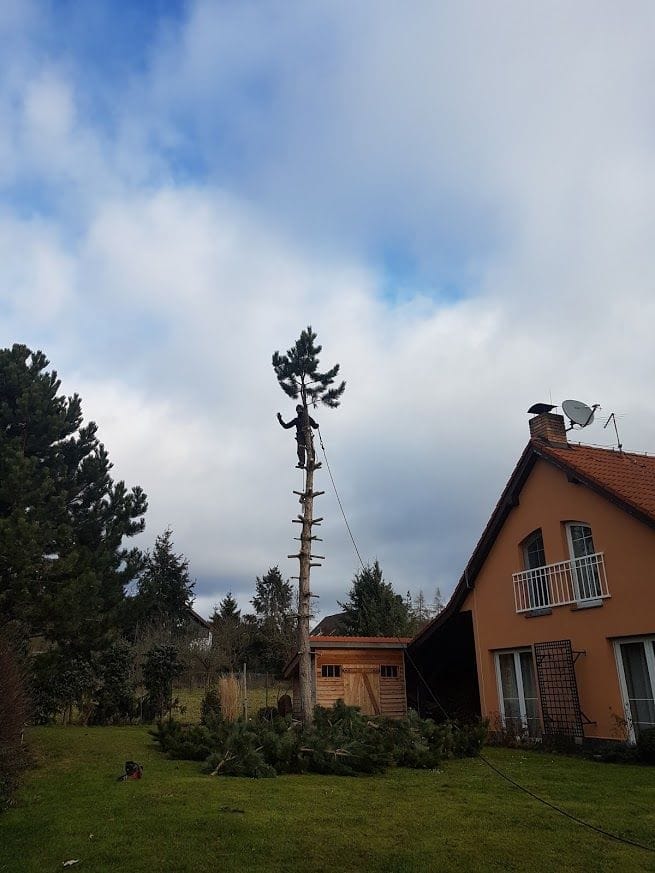
Exit to the crown: A certified arborist (tree climber) climbs into the crown of the tree using special ropes and harnesses.
Removing branches: Branches are gradually cut off. If there is no handling space under the tree, the branches are safely lowered down on ropes (rigging).
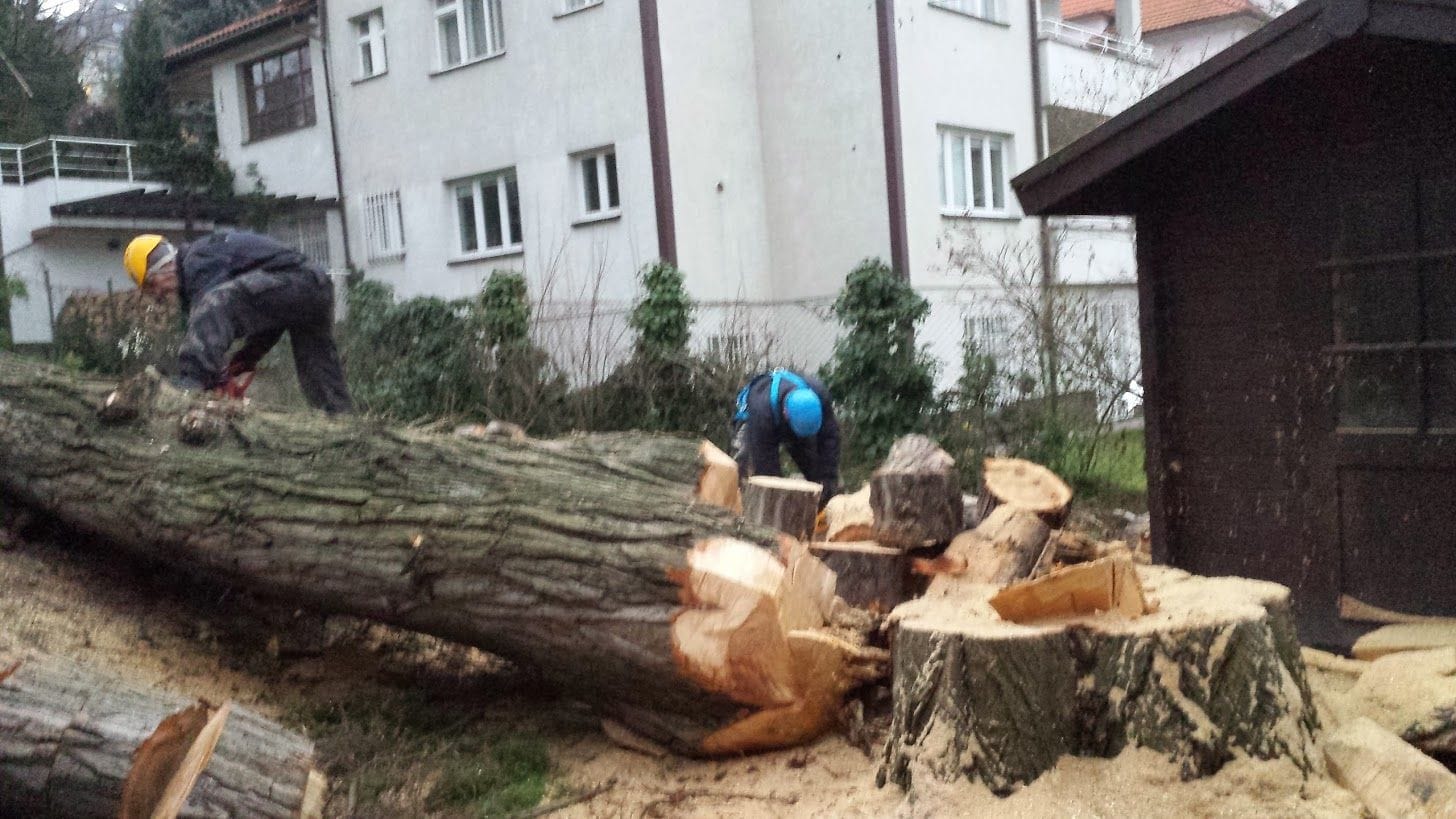
Felling the trunk in parts: The trunk is not cut at the ground, but from top to bottom in short sections that are directed to the impact surface under control.
Cleaning and disposal: After felling, we will arrange crushing of the branches in a wood chipper or complete removal of the wood material as agreed.
When is a felling permit required?
Legislation in the Czech Republic defines clear rules for when you can cut down yourself and when you must ask the authorities:
Without permission: Trees with a trunk circumference of up to 80 cm (measured at a height of 130 cm above the ground) can be felled.
With permission: For trees with a circumference of more than 80 cm, it is necessary to apply for a permit at the relevant municipal office (department of the environment).
Fruit trees: On land registered in the cadastre as a garden or built-up area, fruit trees can usually be cut down without a permit, regardless of their size (this does not apply to memorial trees).
The price of hazardous tree felling: What factors determine it?
The price for hazardous tree felling is never fixed because each tree presents a different challenge. The main factors are:
Difficulty of the surroundings: Is the tree above the greenhouse or in the open area? The less space, the more demanding handling.
Tree Health: Rot or cracks increase the risk to arborists and require more complex securing.
Necessity of lowering loads: If each piece of wood has to be braked with a rope so as not to damage anything, the work takes longer.
Availability: Distance from the road for hauling wood and chipping branches.
Tip: For an exact price quote, just send us a photo of the tree and its surroundings, or arrange a personal inspection.
Why outsource felling to the HardyMT team?
Working at heights with a chainsaw requires maximum experience and certified equipment. At HardyMT, we emphasize the safety of your property and our workers. We are insured for any damage, which is a key standard for hazardous tree felling.
Do you need a professional assessment of your tree? Contact us for a non-binding consultation or check out our current price list of services.